

Create Circus Journal · Travel & Tourism
Multi-Destination Tour Operator Websites: How to Scale Without Rebuilding Every City
Adding a second destination to a tour business can feel relatively simple.
Add another page. Add the new tours. Put the city in the navigation.
Then comes the third city.
And the fifth.
Eventually the operator is no longer maintaining a small collection of tour pages. It is managing a digital network of destinations, experiences, local content, booking inventory, reviews, guides, campaigns and customer journeys.
At that point, the website has a different job.
It cannot simply support today’s list of destinations.
It needs a system for adding the destinations that do not exist yet.
The website should reflect the shape of the business
A single-city operator can often work with a very straightforward architecture.
Homepage.
Tours.
Individual tour pages.
About.
Contact.
Once the business expands geographically, that hierarchy usually stops being enough.
The customer now needs to answer two questions:
Where do I want to go?
and
What do I want to do there?
The website architecture should make both decisions easy.
Think in systems: brand, destination, experience, booking
One useful starting point for a multi-destination operator is:
Brand → Destination → Experience → Booking.
Depending on the business, more layers may exist.
A large European tour company might eventually need:
Brand → Country → City → Experience category → Tour → Booking.
Another operator may have no need for country pages at all.
The architecture should follow genuine customer behaviour rather than creating hierarchy simply because the CMS allows it.
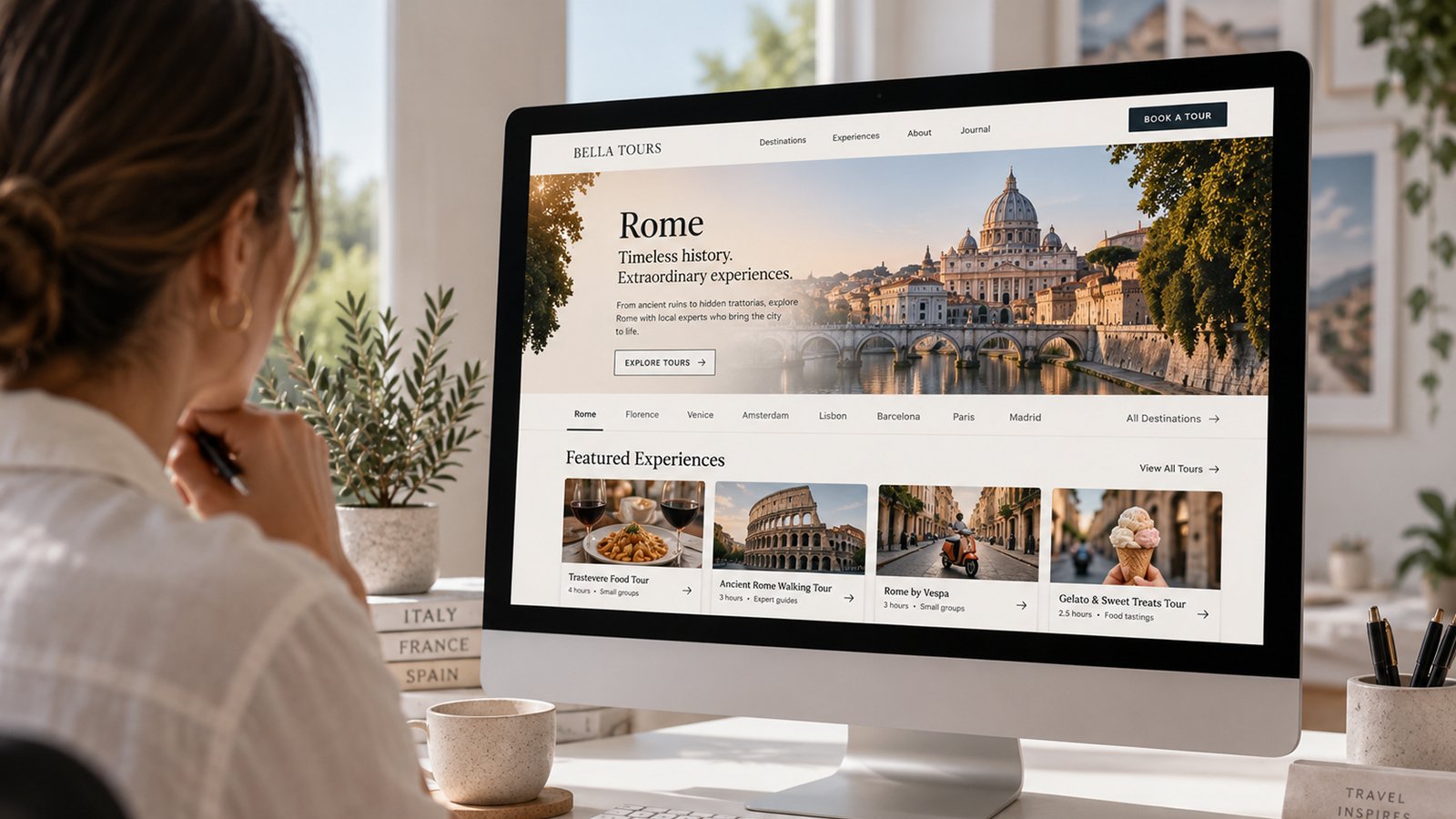
A destination page should become a useful hub
When a company expands, one of the most important templates is the destination page.
It should do more than display a photograph of Rome followed by a grid of tours.
A strong destination page can help travellers understand:
- what the company offers in that city;
- which experiences are most popular;
- how the tours differ;
- which neighbourhoods or attractions they explore;
- which experience fits different types of traveller;
- what local expertise the company has;
- and what useful content exists for planning the visit.
This page becomes both a discovery interface and an SEO hub.
It also gives paid campaigns, social media and email somewhere better to send a traveller than the homepage.
Each tour still needs to stand on its own
Scalable architecture does not mean making every tour page generic.
The template can be shared while the experience remains distinctive.
A reusable tour-page system might consistently support:
- experience positioning;
- hero media;
- duration;
- group size;
- location;
- highlights;
- itinerary;
- food or activity details;
- meeting information;
- reviews;
- FAQs;
- related experiences;
- and booking actions.
The structure is reusable.
The story is not.
Real scale quickly becomes visible in travel
Eating Europe’s current public calendar illustrates the point particularly well.
Travellers can currently browse availability across destinations including Rome, Florence, Paris, Amsterdam, Lisbon, London, Venice, Porto, Madrid, Naples, Milan, Edinburgh, Bologna, Barcelona, Seville, Palermo, Athens, Prague, Berlin and San Sebastian.
That is no longer simply a website containing a collection of food tours.
It is a multi-destination product system.
Each city needs to feel locally credible while remaining recognisably part of one larger brand.
That balance is one of the central design problems in multi-destination travel.
Don’t redesign the website every time you launch a city
Expansion becomes expensive when every destination is treated as a new mini website.
A designer creates another bespoke landing page.
A developer creates another custom template.
The marketing team invents another page structure.
Six months later, the company has ten destination pages that all behave differently.
That makes optimisation difficult too.
If a stronger review layout improves conversion in one city, the business should ideally be able to apply that learning across the system.
Reusable architecture turns improvement into something scalable.
But reusable does not mean identical
The other extreme is equally problematic.
A rigid template can make every city feel interchangeable.
Paris should not feel like Lisbon with different photographs.
Edinburgh should not feel like Rome with the headings replaced.
The system needs controlled flexibility.
That can include optional components, different content emphasis, flexible editorial modules and destination-specific art direction while preserving the core UX patterns that travellers already understand.
Build components around recurring travel needs
Instead of thinking exclusively in pages, we often think in reusable content and interface components.
For example:
- tour-card systems;
- destination introductions;
- local-team modules;
- guide profiles;
- review blocks;
- neighbourhood highlights;
- private-tour promotions;
- availability modules;
- FAQs;
- related guides;
- gift-card modules;
- and booking calls to action.
Those components can then appear in different combinations according to the destination.
The operator gains flexibility without losing consistency.
Expansion should be possible without development
A scalable website should also consider who launches the next city.
Ideally, the internal content or marketing team should be able to create most of a new destination using an established system.
Developers should be needed when the business introduces genuinely new functionality.
They should not be needed because somebody wants to launch the same type of city page for the twelfth time.
That changes the development brief.
The objective is not simply to build today’s website.
It is to build a publishing and commerce system the organisation can operate.
The booking engine needs the same scalability
Website architecture is only one layer.
Underneath it sits operational inventory.
A multi-location operator may be managing different products, capacities, staff, meeting points, prices and distribution relationships across multiple markets.
This is where specialist booking platforms can remain extremely valuable.
Bókun’s City Rome Tours case, for example, describes the operator managing destinations including Rome, Barcelona and Lisbon through one account, with bookings and inventory centralised across cities and countries.
That illustrates an important principle:
The customer-facing website and the operational booking system should be designed to scale together, but they do not need to be the same system.
One booking engine can support many destination experiences
The traveller does not necessarily need to know how the operational architecture works.
They need a clear experience.
Someone browsing Barcelona should see Barcelona-specific tours and availability.
Someone browsing Lisbon should remain inside the Lisbon journey.
Behind the interface, the same reservation platform may be managing both.
That separation gives the business room to create a stronger branded website without unnecessarily recreating booking infrastructure.
Keep the transition into booking consistent
Scale can expose inconsistencies quickly.
One city uses embedded booking.
Another opens an external page.
One tour shows dates immediately.
Another asks the customer to click twice before availability appears.
Those inconsistencies often emerge gradually as the business expands.
A redesign is an opportunity to establish booking principles that apply across destinations.
Where should availability appear?
When should the customer see price?
What happens on mobile?
Which reassurance appears before payment?
How do private experiences differ from scheduled departures?
Those decisions should become part of the system.
SEO also benefits from predictable destination architecture
Multi-destination expansion can create a powerful organic-search structure if it is planned early.
Each city can become a coherent topic cluster containing:
- a destination hub;
- individual tour pages;
- private experiences;
- local guides;
- neighbourhood content;
- planning articles;
- FAQs;
- and relevant internal links.
The architecture gives search engines a clearer relationship between the brand, destination and commercial experiences.
More importantly, each new city can follow an established SEO framework rather than inventing one after launch.
Don’t create a country layer unless it serves a purpose
Scalable architecture should not become architecture for architecture’s sake.
If an operator has tours only in Rome, creating an Italy hierarchy may add little value.
Once the same company operates Rome, Florence, Venice, Naples, Milan and Bologna, an Italy hub may become considerably more useful.
It can help travellers explore between cities, consolidate regional content and give the search architecture another meaningful level.
The rule is simple:
Create hierarchy when it helps somebody understand or discover the offer.
The design system needs to scale without making every city feel identical
This is where brand design becomes especially important.
A multi-city operator is selling both consistency and locality.
The customer wants confidence that the company they trusted in Rome is also credible in Lisbon.
At the same time, they do not want Lisbon to feel like a generic product generated from the Rome template.
The design system needs stable brand elements and flexible local expression.
Stable elements might include:
- typography;
- button styles;
- navigation behaviour;
- tour cards;
- booking interactions;
- review presentation;
- and the core colour system.
Flexible elements might include:
- photography;
- local storytelling;
- editorial compositions;
- destination accents;
- guide personalities;
- local food or cultural references;
- and destination-specific content modules.
That creates recognition without sameness.
Brand architecture becomes harder when sub-brands appear
Geography is not always the only axis of expansion.
A travel group may also launch:
- a premium private-tour concept;
- a nightlife product;
- a culinary experience brand;
- a family-focused range;
- a corporate-events proposition;
- or a completely different tour format.
Now the business has two questions:
Where does the experience operate?
And which brand does it belong to?
This is where digital architecture and brand architecture need to be planned together.
Not every new concept needs another website
Creating another domain can initially feel like the cleanest way to launch a new travel concept.
It also creates another:
- SEO property;
- analytics setup;
- CMS;
- cookie configuration;
- maintenance requirement;
- content system;
- navigation;
- and marketing asset.
Sometimes a separate brand genuinely deserves a separate digital property.
Sometimes the same goal can be achieved through a flexible parent system.
The decision should be strategic rather than cosmetic.
Mobile navigation gets harder as destinations multiply
Adding destinations to desktop navigation is relatively easy.
Mobile is less forgiving.
Twenty destinations, several tour categories, private tours, gift cards, editorial content and account or booking actions cannot all receive equal visual priority.
The navigation needs hierarchy.
Travellers may need to choose the destination first, search by experience, access recently viewed tours or quickly return to availability.
These are UX decisions rather than menu-design details.
Destination detection can help, but do not take control away from the traveller
A growing tour business may be tempted to automatically route visitors according to location.
That can occasionally be useful.
But a visitor in London may be planning Rome.
A traveller already in Paris may be booking Amsterdam for next week.
Geography should therefore assist discovery rather than assume intent.
Clear destination switching is usually more valuable than aggressively forcing localisation.
Reviews should scale locally too
Social proof becomes more persuasive when it matches the decision.
A traveller considering a Lisbon food tour is likely to care more about recent Lisbon experiences than a generic review of the company’s Rome operation.
A scalable system can therefore associate reviews with:
- the overall brand;
- specific destinations;
- individual tours;
- or particular guides.
That makes the same review ecosystem considerably more useful for conversion.
Local teams are part of the product
One of the strongest ways for a multi-destination operator to avoid feeling generic is to make local expertise visible.
Eating Europe currently does this directly on destination pages, introducing local teams and connecting their knowledge to the neighbourhoods, food and culture behind the tours.
That is more than an About Us device.
It answers an important trust question:
Does this international brand genuinely know this particular city?
For scalable tourism businesses, local credibility should be part of the content system.
AI-assisted production can help expansion without flattening local voice
Launching destinations creates significant content work.
Tour descriptions.
Practical information.
Destination introductions.
FAQs.
Metadata.
Guide profiles.
Internal links.
AI-assisted workflows can make that production significantly more efficient.
But we would use AI to organise and accelerate original expertise rather than generate interchangeable city copy.
A useful workflow might begin with interviews or structured information from the local team, then use AI to help turn that source material into consistent drafts.
The system provides consistency.
The people provide specificity.
AI discovery also rewards explicit destination information
Current travel discovery is becoming increasingly conversational.
HBX Group’s 2026 trends report highlights growing use of AI tools in trip planning alongside social-led destination discovery.
For a multi-destination operator, that increases the value of explicit product information.
A tour page should make it easy to understand:
- the city;
- neighbourhood;
- experience type;
- duration;
- group size;
- age suitability;
- physical requirements;
- food or activity characteristics;
- availability;
- and other meaningful attributes.
Clear structure helps people first.
It also gives search and AI systems better information to work with.
Analytics should be segmented by destination
Once a tour company spans several cities, overall website conversion rate becomes less informative.
Rome may behave very differently from Berlin.
Organic search may dominate in one destination while paid social drives another.
One city’s customers may book weeks in advance while another has a strong last-minute market.
Reporting should therefore be able to answer:
- Which destinations attract the most traffic?
- Which produce the most direct bookings?
- Which tours convert best?
- Which markets rely more heavily on OTAs?
- Where do mobile users abandon booking?
- Which destination content creates booking journeys?
- Where is organic visibility growing?
This makes optimisation substantially more precise.
A shared system makes CRO scalable too
This is one of the strongest arguments for component-based design.
Imagine testing a new booking CTA arrangement on several high-traffic tour pages.
If the structure improves conversion and the component is shared, the learning can eventually benefit a much larger part of the website.
The same applies to:
- review placement;
- mobile booking bars;
- FAQ structures;
- tour comparison;
- availability presentation;
- and cross-selling related experiences.
The website becomes an optimisation platform rather than a collection of individually designed pages.
Performance needs governance as the site grows
More destinations usually mean more content, media and integrations.
Without discipline, the site accumulates:
- oversized photography;
- video;
- review widgets;
- booking scripts;
- tracking tags;
- chat;
- maps;
- and campaign tools.
Travel sites are particularly vulnerable because rich visual storytelling is genuinely important.
The answer is not to remove the experience.
It is to establish performance standards for the system and keep them in place after launch.
The CMS needs governance too
Multi-destination businesses often have several people editing the site.
Central marketing.
Local teams.
SEO partners.
Developers.
Content producers.
Without a structured CMS, inconsistency grows quickly.
One destination uses different heading styles.
Another uploads enormous images.
Another creates a new module because the existing one was difficult to find.
Good development should make the correct way of publishing easier than the incorrect one.
Internationalisation is more than translation
Some multi-destination operators eventually expand into multiple languages or markets.
That adds another architectural dimension.
Currency, dates, measurements, availability, customer service, legal information and search behaviour can all vary by market.
A website built for one city and one language may become increasingly difficult to adapt if international growth was never considered.
Not every operator needs multilingual infrastructure from day one.
But the technical and URL architecture should avoid making it unnecessarily difficult later.
What should happen when you add the next city?
A useful test of a multi-destination website is to imagine tomorrow’s expansion.
Suppose the business decides to launch Copenhagen.
What needs to happen?
In a scalable system, the process might look like:
1. Create the destination within the existing hierarchy.
2. Add the new experiences using established tour templates.
3. Populate local content and photography.
4. Connect the appropriate booking products.
5. Apply existing structured information and SEO rules.
6. Add destination-specific reviews and local expertise.
7. QA mobile, analytics and booking measurement.
Then launch.
If adding one city requires redesigning the global navigation, creating multiple new templates and writing custom code throughout the site, the existing architecture is probably carrying too much historical debt.
A useful scalability question:
If your tour company opened another destination next month, could your internal team launch most of it using the system you already have?
If the answer is no, the website may have been designed around today’s content rather than tomorrow’s business.
Scalable does not mean impersonal
There is a common tension in digital travel.
Systems create efficiency.
Travel is sold through emotion, culture and human experience.
Good multi-destination design has to support both.
The page structure can be systematic.
The photography can be local.
The booking interaction can be consistent.
The storytelling can belong completely to the neighbourhood.
The CMS can be structured.
The guide’s voice can still feel human.
That is what the system is for.
It removes repetitive digital work so more attention can go into what makes each destination worth visiting.
Design for the twenty-first destination before you launch the fifth
Multi-destination growth changes a tour website from a marketing asset into digital infrastructure.
Brand architecture matters.
UX matters.
SEO architecture matters.
Booking integrations matter.
CMS design matters.
Analytics matter.
CRO matters.
Performance matters.
And they increasingly need to be designed as parts of the same system.
At Create Circus, this is how we approach larger travel and tourism projects: not as a sequence of individual destination pages, but as a framework the organisation can continue using as products, destinations and sub-brands evolve.
The goal is not to make every city look the same. It is to stop rebuilding the business every time you add one.
Sources and further reading
Eating Europe: current destination and tour network.
Bókun: City Rome Tours multi-destination booking management case study.
HBX Group: 2026 Travel Trends Report.
Arival: 2026 Multi-Day Tour Operator technology and distribution programme.
Travel Strategy · Brand Systems · UX/UI · Development · Booking Integration · SEO · CRO
Is your tour business growing faster than the website was designed to?
We help multi-destination tour operators and travel brands turn growing collections of cities, experiences and booking systems into scalable digital platforms.
That can include strategy, brand architecture, UX/UI, reusable destination systems, development, booking-platform integration, SEO, CRO, AI-assisted content workflows and ongoing optimisation.