


E-COMMERCE DEVELOPMENT
How Much Does an Ecommerce Website Cost in the UK? 2026 Guide
Last updated: 22 September 2026
How much does an ecommerce website cost in the UK?
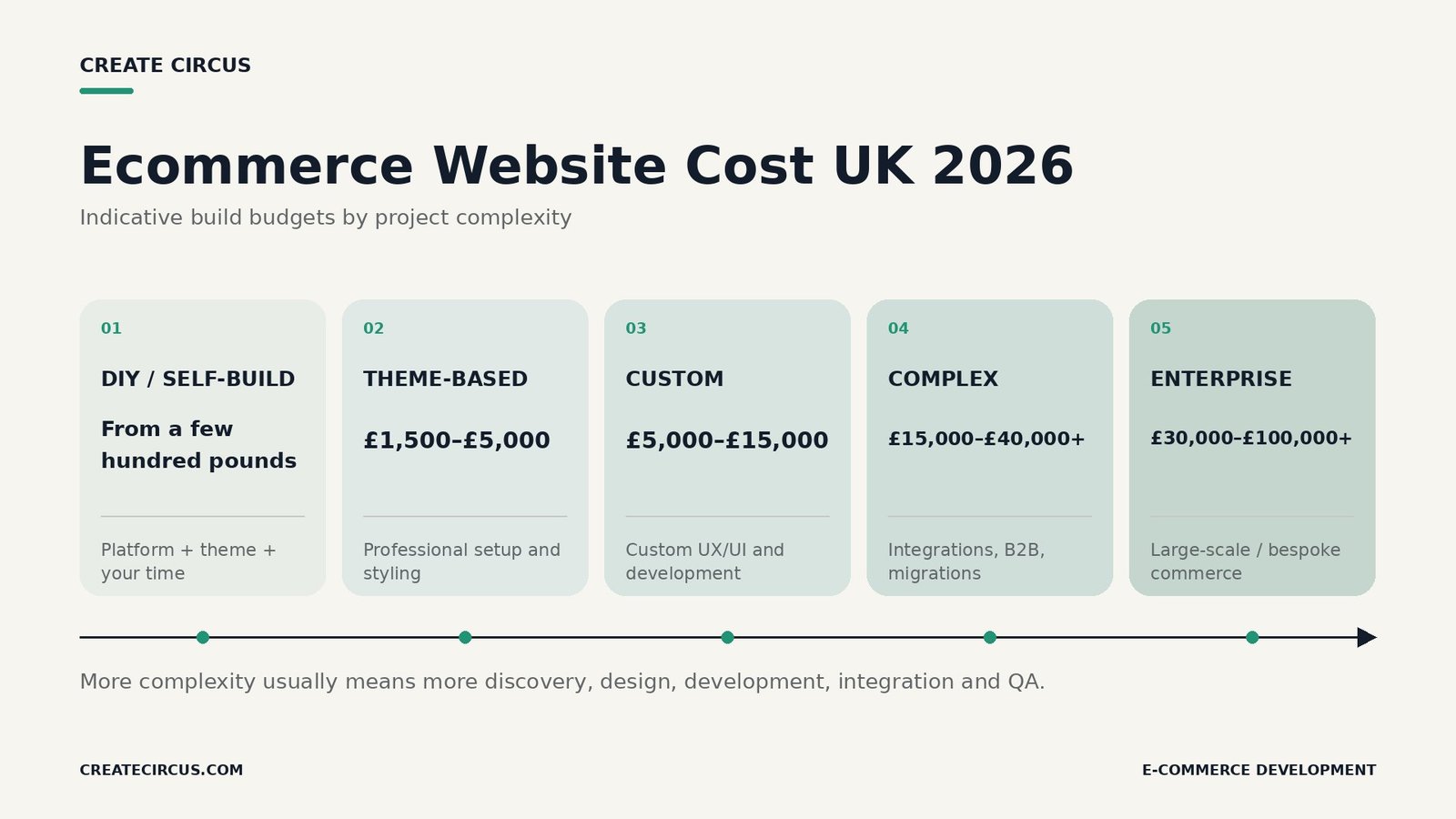
For planning purposes, a professionally delivered store can range from around £1,500–£5,000 for a straightforward theme-based project, through £5,000–£15,000 for a custom ecommerce build, to £15,000–£40,000+ when the project involves integrations, large catalogues, B2B, international architecture or more bespoke functionality.
A DIY store can cost far less. A large enterprise or highly bespoke ecommerce programme can cost considerably more.
The range is wide because “an ecommerce website” is not one standard product. A founder setting up a small Shopify catalogue and an established retailer migrating thousands of products, customers, URLs and integrations are buying very different projects.
This guide breaks down where the money actually goes, what sits outside the initial development quote, and how to compare ecommerce proposals properly.
Ecommerce website cost UK: quick comparison
These are practical planning ranges rather than fixed industry tariffs. Platform, scope, catalogue complexity, migration requirements and integrations can move an individual project substantially above or below them.
Why ecommerce website quotes vary so much
Two proposals can both say “ecommerce website” and contain completely different amounts of work.
One quote might assume that you already have a brand, finished copy, photography, product data and a Shopify theme selected.
Another might include discovery, UX, custom UI design, development, product migration, redirects, analytics, technical SEO, integrations and post-launch support.
Comparing only the final number tells you very little unless the scopes are actually comparable.
1. DIY ecommerce website: from a few hundred pounds
The cheapest route is to build the store yourself using a hosted ecommerce platform or an existing theme.
Your direct costs may include the platform, domain, theme, apps or extensions, payment processing, photography and content.
The less visible cost is your time.
You become responsible for structure, product setup, navigation, design decisions, testing and the technical details that an agency or developer would otherwise handle.
This can still be the right route when you are testing a product, working with a small catalogue or validating demand before making a larger investment.
2. Professional theme-based ecommerce store: £1,500–£5,000
A professionally configured theme is usually the next step up.
Instead of designing every component from scratch, the project starts with an established Shopify or WooCommerce theme and adapts it around the brand.
A typical scope can include:
- theme selection and setup;
- brand styling;
- homepage configuration;
- collection and product templates;
- navigation;
- essential apps or extensions;
- basic product setup;
- responsive QA;
- analytics and technical SEO foundations.
For a smaller catalogue and relatively standard customer journey, this can be a very sensible investment.
The limitation is that the project still works primarily inside the structure of the chosen theme.
3. Custom ecommerce website: £5,000–£15,000
Custom ecommerce work becomes more relevant when the business needs the website to reflect its own customer journey rather than simply adapt to a pre-built layout.
This can include:
- discovery and strategy;
- information architecture;
- UX and wireframing;
- custom UI design;
- a reusable design system;
- custom sections and templates;
- product and collection architecture;
- development;
- third-party integrations;
- technical SEO foundations;
- analytics;
- launch QA.
This is often where an established brand begins to feel the difference between simply having an online shop and having a storefront designed around how its customers actually browse and buy.
If you want to understand what this level of work involves, our web design and web development services explain the design and technical sides separately.
4. Complex ecommerce build: £15,000–£40,000+
Costs rise quickly when the difficult part of the project sits behind the visible pages.
A store might need:
- ERP integration;
- CRM integration;
- custom inventory logic;
- subscriptions;
- advanced bundles;
- B2B or wholesale functionality;
- large-scale catalogue migration;
- several markets or languages;
- custom search and filtering;
- complex pricing logic;
- custom customer-account functionality;
- multiple fulfilment systems.
At this level, technical planning becomes just as important as visual design.
A beautiful storefront is not useful if the store cannot reliably exchange products, customers, inventory and orders with the systems running the rest of the business.
5. Enterprise and highly bespoke ecommerce: £30,000–£100,000+
Enterprise ecommerce is difficult to price as a category because the storefront may be only one part of the programme.
The work can involve several regions, B2B and DTC, large development teams, international tax and payments, ERP architecture, sophisticated permissions, advanced checkout requirements and extensive data migration.
At this scale, the cost of discovery, architecture, testing and deployment normally grows alongside the development itself.
How much does the ecommerce platform cost?
Your website design and development fee is separate from the platform that runs the store.
Shopify UK pricing
As of September 2026, Shopify currently lists these UK prices when billed yearly:
- Basic: £19 per month;
- Grow: £49 per month;
- Advanced: £259 per month;
- Shopify Plus: from £1,800 per month on a three-year term.
Monthly billing for Basic, Grow and Advanced is higher.
Because Shopify pricing changes more frequently than the cost of a web project, we maintain a separate Shopify Pricing UK guide rather than turning this article into a second pricing page.
WooCommerce costs
WooCommerce itself is free and open source.
That does not mean a WooCommerce store costs nothing to operate.
You normally budget separately for hosting, WordPress maintenance, payment processing, extensions, security and development support.
Hosting, extensions and ongoing technical support can vary considerably depending on the size and complexity of the store.
What actually increases ecommerce website cost?
Custom UX and UI
Adapting an existing theme takes less time than researching and designing a customer journey specifically for the brand.
Custom design becomes valuable when differentiation, catalogue complexity or buying behaviour justifies it.
Number of unique templates
Product count does not always determine project cost.
A store with 5,000 products using one clean data structure can sometimes be simpler than a 50-product store where each category needs a different buying journey.
What often matters more is the number of unique templates and behaviours that need to be designed and developed.
Product and variant complexity
Sizes, colours, bundles, subscriptions, customisation, configurable products and unusual availability rules can all add work.
Integrations
An integration can mean a simple app installation or a significant technical project.
ERP, warehouse, CRM, booking, subscription and custom API integrations should be scoped individually rather than hidden under a generic “integrations included” line.
Migration
Migrating an established ecommerce store is very different from launching a new one.
You might need to preserve:
- products and variants;
- customers;
- orders;
- URLs;
- redirects;
- organic-search visibility;
- reviews;
- subscriptions;
- analytics;
- integrations.
A redesign that loses years of useful search visibility or breaks the operational workflow is not a successful redesign.
International selling
Multiple currencies, languages, regional domains, tax, duties, shipping and local payment expectations can all increase project complexity.
B2B
Wholesale and B2B can introduce company accounts, catalogues, customer-specific pricing, payment terms and operational workflows that do not exist in a straightforward DTC store.
What ongoing ecommerce costs should you budget for?
The launch quote is only the initial investment.
A realistic ecommerce budget should also consider the ongoing operating stack.
Platform and hosting
Hosted platforms charge a recurring subscription. Self-hosted platforms require separate hosting and maintenance.
Payment processing
Payment providers normally charge transaction-processing fees. Those costs can become significant as revenue increases, so they should be part of the financial model rather than treated as an afterthought.
Apps and extensions
Reviews, subscriptions, search, returns, loyalty, bundles, email, translation and other functionality can create a meaningful monthly software bill.
Apps should earn their place in the stack.
Maintenance and development
Stores continue changing after launch.
Campaigns, merchandising, new functionality, platform changes, fixes and integrations all create ongoing development requirements.
Content
Product photography, video, copywriting, landing pages and ongoing editorial content should be budgeted separately when they are not part of the build.
Analytics and optimisation
Analytics, user testing and conversion work become more useful once the store has enough real customer behaviour to analyse.
The aim should be evidence-led improvement rather than continuously redesigning the website based on assumptions.
What should be included in an ecommerce website quote?
Before comparing agencies or developers, check whether each proposal actually includes the same work.
Look for clarity around:
- discovery and strategy;
- information architecture;
- wireframes;
- UI design;
- responsive design;
- development;
- content population;
- product migration;
- customer or order migration;
- apps and integrations;
- technical SEO foundations;
- redirects;
- analytics;
- performance;
- QA;
- launch;
- post-launch support.
A £4,000 design-and-development quote is not directly comparable with a £3,000 development-only quote that expects finished designs, copy and product data to be supplied.
Freelancer, agency or DIY?
DIY
Most appropriate when budget is the main constraint and the store is relatively straightforward.
Freelancer
Can be highly effective when the project has a clearly defined requirement that matches the freelancer’s specialism.
Agency
Becomes more useful when several disciplines need to work together: strategy, UX, design, development, QA, technical SEO foundations and integrations.
The right model depends on the project rather than the label.
How much should your business spend?
There is little reason for a new product idea to commission an enterprise ecommerce build before demand has been tested.
Likewise, an established retailer should not force a complicated operation into the cheapest possible theme setup simply because the initial quote is lower.
We would normally look at four questions:
- How proven is the business?
- How important is ecommerce to revenue?
- How unusual is the customer or operational journey?
- What does the store need to support over the next two or three years?
The right budget is the one that fits the stage of the business and solves the limitations that are actually holding it back.
Do not judge ecommerce cost by design alone
Two stores can look equally polished on the homepage and have completely different levels of technical work underneath.
A strong ecommerce project connects design with catalogue structure, the buying journey, data, integrations and the way the business needs to operate after launch.
That is why the most useful way to understand cost is to define the scope before comparing prices.
Planning an ecommerce website?
If you already know you need a store, redesign or migration, start by documenting the business requirements rather than trying to choose a package from a price table.
At Create Circus, we work across ecommerce strategy, UX/UI, Shopify development, migrations, integrations, technical SEO foundations and ongoing optimisation. We scope projects around what the business actually needs rather than forcing every store into the same build.
Sources and further reading
Shopify UK: Current plan pricing
WooCommerce: Current platform and operating-cost guidance
Google Search Central: Ecommerce merchant listing structured data
Shopify Partner since 2021
Planning your next Shopify move?
If you are planning a new Shopify store, considering a redesign or trying to understand what your current store needs next, tell us where the business is today.
We’ll help you work out the right next step and build a Shopify experience designed around where you want to take it.